Monday, October 11, 2010

Starting in Edinburgh

The process of determining which destination marathon to tackle next has been a challenge. I'm looking all over the world, but a few places seem to be rising to the top. Out of them all, the one that seems to make the most sense is the Edinburgh marathon in Scotland.

Beyond being one of a few obvious choices, this marathon gives me the ability to return to London and stay for a few days. That gives me the chance to walk up to my favorite, the Prince of Wales Pub in Chelsea. Add to that a nice train ride between London and Edinburgh and the chance to use my library membership at the Chelsea and Kensington branch and the trip really begins to take shape.

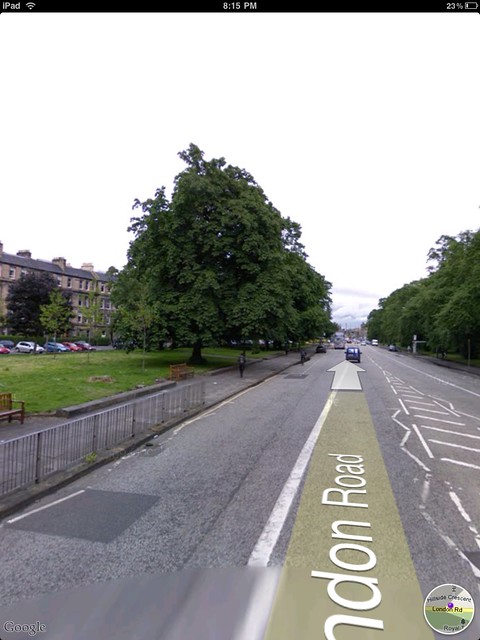
I decided to look up some more detailed race information. The image below is of the starting location of the race. It certainly doesn't look like much now, but add the expected 30,000 participants and fans and you've got quite the event lined up for May in the northern U.K.

Photo 3 - 2010-10-11

Monday, October 4, 2010

Gaining Perspective on Backyard Rivalries

As I was flying somewhere over the South Atlantic, the best thing I found to pass the time was the movie "Ratatouille". Even with the great seat back tv screens and near-decent selection, "Ratatouille" was the only thing that seemed to pass the time. In the movie, Anton Ego famously orders up "some perspective" and a bottle of Cheval Blanc 1947.

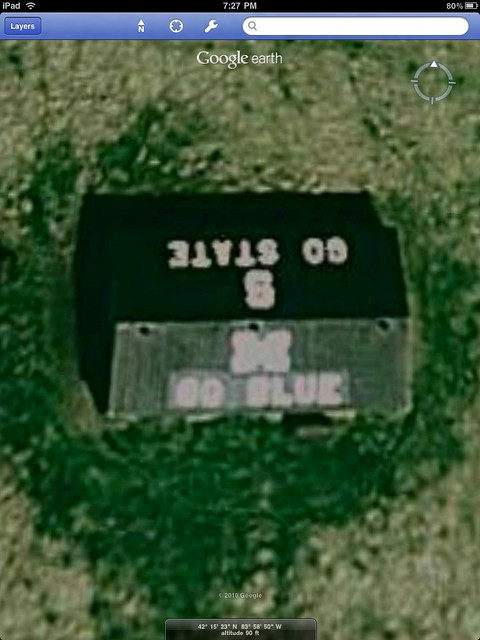
Today, as I was driving near Ann Arbor, I noticed a barn with "Go State" on the roof. Michigan State is a bitter University of Michigan rival. Growing up in Ann Arbor, I've always been a Michigan fan.

Somewhat disappointed about the show of Spartan love not far from the University of Michigan, I was reminded of the movie quote on perspective when I found the barn this evening on Google Earth.

go blue beat state.

I gained some perspective and learned it wasn't just a state barn. Instead, it provides some insight to the "backyard brawl" mentality that fuels this rivalry- one that divides houses, both figuratively and even literally for at least one week a year.

Speaking of perspective, either the Michigan Wolverines or the Michigan State Spartans and their fans will get a dose of perspective after the two teams meet on the gridiron this Saturday at 3:30 at the Big House in Ann Arbor.

Friday, September 24, 2010

Popularity of Google in Africa

The World Wide Web resembles its moniker more and more each day. While the Internet has spread quickly in western countries, its roll out has been much slower in other areas of the world, especially Africa. Fortunately, global Internet giants like Google are able to take advantage of some of the expanding African web infrastructure provided by companies like SEACOM.

Each country is assigned a Top Level Domain (TLD) by the Internet Assigned Numbers Authority. You're probably most familiar with TLD country codes like .us for the United States and .uk for the United Kingdom. What you might not know is that your favorite link shortener bit.ly uses the Libyan TLD .ly.

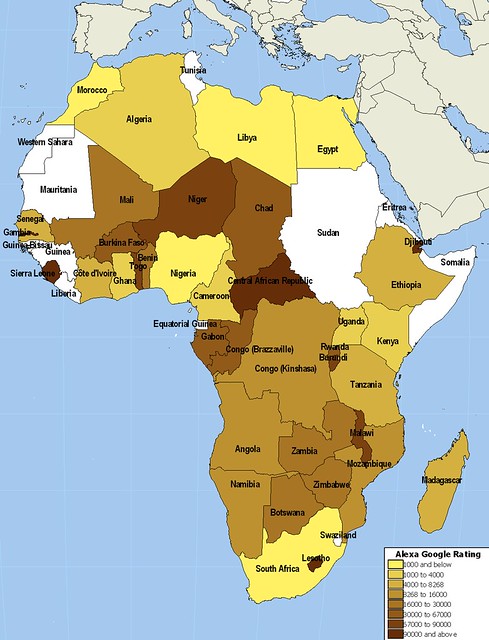
Google, in their infinite wisdom, wealth and power have provided customized Google search pages for almost all the countries in the world. I decided to look at the popularity of the African TLD Google pages. I was able to find pages for almost every African country. Often, the extension includes .co before the country code such as www.google.co.bw for Botswana.

I used Alexa, the Internet traffic reporting site, to get the site rank for each Google country TLD available. I've included the results a few different ways. First, the map below breaks down countries into eight categories based on the Alexa rankings. The African countries rank between the 138th most viewed site on the Internet, Google Egypt, and number 524,835, Google Central African Republic. At last check Worldgeoblog.com was in the 5 millions ;) I've also included links to each of the sites that are ranked below the map. Last, I'm providing the kml file which includes Country Name, Alexa rank and URL.

Africa Google Alexa Ranking

Algeria
Angola
Benin
Botswana
Burkina Faso
Burundi
Cameroon
Cape Verde
Central African Republic
Chad
Comoros
Congo (Brazzaville)
Congo (Kinshasa)
Côte d'Ivoire
Djibouti
Egypt
Equatorial Guinea
Eritrea
Ethiopia
Gabon
Gambia
Ghana
Guinea
Guinea-Bissau
Kenya
Lesotho
Liberia
Libya
Madagascar
Malawi
Mali
Mauritania
Mauritius
Morocco
Mozambique
Namibia
Niger
Nigeria
Rwanda
Sao Tome and Principe
Senegal
Seychelles
Sierra Leone
Somalia
Somaliland
South Africa
Sudan
Swaziland
Tanzania
Togo
Tunisia
Uganda
Western Sahara
Zambia
Zimbabwe

Wednesday, September 22, 2010

The Old Man in the Prince of Wales Pub

I had been in London for about 5 hours, intentionally trying to get lost and had more or less succeeded when I happened upon a little old pub in Chelsea. Satisfied that it was time for a pint, I walked up the steps of the Prince of Wales pub at the corner of Old Brompton Road and Empress Place. I tried to open both of the entryway doors to no avail. Just as I turned around to find another pub, and old man, whom I hadn't yet noticed told me that it would only be a moment or so before the pub opened. I'm sure he used a much more whimsical and creative phrase but it has since escaped me.

Shortly after, the doors were opened and the old man and I walked in. I found a seat at a table by myself and ordered from the bartender who was doubling as my waiter. After a few minutes and half of my first pint I wandered over to the old man who was sitting a few tables over. Eager to engage in a conversation with a Brit, I told him how impressed I was with the little bar and we engaged in some great chit chat.

The man had some serious health issues. Probably in his 70's, he had difficulty walking and spoke with a soft voice. I was still trying to get a sense of Londoners and wondering what they thought of me. After speaking a little bit about our respective countries' interest in "football" the man provided me with some insight into his existence. He said that his doctor had told him that if he didn't quit drinking and smoking he would die. To that, he told me. "This, this fag I can live with out but I'll be damned if I don't die with a pint in my hand". It was a simple quote but one that was more endearing than you can imagine.

For me this little anecdote sort of encapsulated my London experience, especially because all of my pictures were deleted. While most trips have pictures, this one is only memories. My adventure in London is now all in my head. I'll never forget that bar, nor the old man who sat outside with me waiting for it to open.

Because all of my pictures were deleted it was important to me to find the pub where I had such a fond memory. When I returned home I took it upon myself to find my favorite London pub. Despite walking around the city, lost, for just shy of 11 hours, I had a fairly good idea of where I had gone and I didn't think it would be hard to find. This goes to show that with a good sense of an areas geography and direction it's hard to ever really be lost. I recognized many of the places I went while I looked around London in Google Earth. I knew the pub was near Brompton Cemetery which, despite forgetting the name (as was the case with the pub) was easy to find. I looked everywhere to the north and the east but couldn't find my pub!

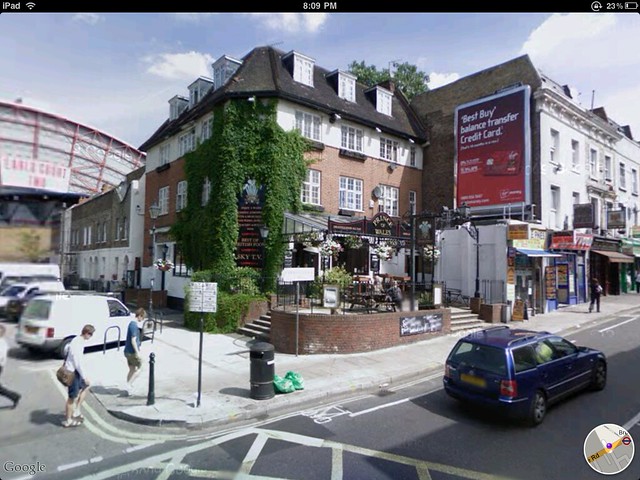
It was more than a year later before I happened upon the Prince of Wales pub in Chelsea in Google Earth just to the southwest of the cemetery. I've included a picture from Google Earth Street View below.

Prince of Wales Pub

It's a very special place, very far away. I hope you get the opportunity to go there someday.

I enjoy hearing other peoples stories about travels. The personal side to trips are usually the most interesting to read about. I encourage you to write stories of your own travels on your blog. Be sure to let me know by leaving a comment. Check out some great take aways of Catholicgauze's trip to Saudi Arabia.

Tuesday, September 21, 2010

The Failed States Index 2006 to 2010

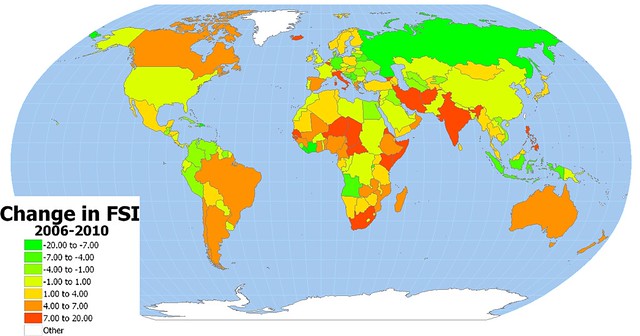
Each year the Fund for Peace and Foreign Policy provide us with a fascinating look at the state of the States using the Failed States Index (FSI). The index is created from scores of 12 categories divided into social, economic and political indicators. The worst possible score on the index is 120, a truly failed State. The best score possible, 12, is some sort of unimaginable paradise. States are given a score and based on that score, given a status of either sustainable, moderate, warning or alert.

While surfing the internet looking for discussion of the FSI rankings I found that much more attention is given to the rank of States on the index rather than their score. This is unfortunate because the real power in the failed states index is the in-depth analysis and score. It's also a great way to examine the overall direction of a State. These are not arbitrary numbers assigned to each category based on minimal research. Each category for each State is researched as extensively as possible. As such, the score is much more important than the rank.

I took scores from the 2006 Failed States Index and 2010 Failed States Index to look at the change over that 4 year period. While the index dates back to 2005, the scores were not as extensive and a lot of data was unavailable. The 2006 data (and select data from 2007) provides a much better point of comparison to the 2010 data. Realisitcally, four years isn't enough time to fairly evaluate an administration or regime with this deep an analysis. Fixing a failed state takes time. Still, examining the failed states index over even a short period of time provides insight into a country and even the state of the world.

Below is the map I made showing the change in score from 2006 to 2010. Note that the negative values reflect a better score, this is to say green represents those States which have improved the most while red shows those who are moving away from order.

Change in Failed States Index with legend

If you're interested I've made the KML file available here.

I've listed 161 States in rank order of FSI score change from 2006 to 2010. South Africa has had the greatest change in the wrong direction from 55.7 in 2006 to 67.9 in 2010. The last, Montenegro improved its score from 83.8 in 2006 to 57.3 in 2010 however it should be noted that the 2006 ranking is for both Serbia and Montenegro. The FSI score of Serbia improved to 77.8 in 2010.

1 South Africa
2 Kenya
3 Guinea-Bissau
4 Niger
5 Italy
6 Lebanon
7 Afghanistan
8 Eritrea
9 Central African Republic
10 India
11 Iceland
12 Senegal
13 Somalia
14 Iran
15 Georgia
16 Belgium
17 Philippines
18 Chad
19 Cameroon
20 Mozambique
21 Ethiopia
22 Ghana
23 Gambia
24 Spain
25 Madagascar
26 Guinea
27 Chile
28 Benin
29 Nigeria
30 Australia
31 Israel
32 Argentina
33 Oman
34 Greece
35 Canada
36 Mali
37 Equatorial Guinea
38 New Zealand
39 Zambia
40 Brazil
41 Singapore
42 Thailand
43 Malawi
44 Namibia
45 Ireland
46 Cambodia
47 Algeria
48 Yemen
49 Hungary
50 Japan
51 Sri Lanka
52 Honduras
53 Malaysia
54 Switzerland
55 Uganda
56 Mexico
57 Burma
58 Tanzania
59 Sweden
60 Turkey
61 Armenia
62 Azerbaijan
63 Mauritius
64 Costa Rica
65 Tunisia
66 Bolivia
67 El Salvador
68 Norway
69 Bahrain
70 Gabon
71 Mongolia
72 Botswana
73 Djibouti
74 Tajikistan
75 Swaziland
76 South Korea
77 Zimbabwe
78 Mauritania
79 Moldova
80 Poland
81 Finland
82 Austria
83 Burkina Faso
84 Lesotho
85 Laos
86 Kazakhstan
87 United Arab Emirates
88 United States
89 Kuwait
90 Jamaica
91 France
92 Libya
93 North Korea
94 China
95 Ecuador
96 Morocco
97 Portugal
98 Saudi Arabia
99 Nicaragua
100 Paraguay
101 Uruguay
102 Burundi
103 Nepal
104 Jordan
105 Congo (Kinshasa)
106 Bangladesh
107 Togo
108 Netherlands
109 Guyana
110 Estonia
111 Malta
112 Czech Republic
113 Panama
114 United Kingdom
115 Sudan
116 Congo (Brazzaville)
117 Pakistan
118 Bhutan
119 Syria
120 Papua New Guinea
121 Slovenia
122 Luxembourg
123 Latvia
124 Bulgaria
125 Belize
126 Slovakia
127 Suriname
128 Albania
129 Iraq
130 Qatar
131 Kyrgyzstan
132 Denmark
133 Egypt
134 Lithuania
135 Vietnam
136 Peru
137 Macedonia
138 Romania
139 Cuba
140 Venezuela
141 Cyprus
142 Croatia
143 Haiti
144 Sierra Leone
145 Guatemala
146 Ukraine
147 Colombia
148 Turkmenistan
149 Uzbekistan
150 Rwanda
151 Germany
152 Angola
153 Bosnia and Herzegovina
154 Belarus
155 Serbia and Montenegro
156 Indonesia
157 Liberia
158 Côte d'Ivoire
159 Russia
160 Dominican Republic
161 Montenegro

Monday, September 20, 2010

Urban Transport: Detroit and Nouakchott

Vast amounts of developable land, capitalism and access to fast moving personal transportation is a potent mix for sprawl, a phenomenon as American as baseball, apple pie or high fructose corn syrup.

While the invention of the automobile was a huge factor in fostering an emerging middle class, it greatly increased the ability of people to travel farther on a daily basis. Living within walking distance of a grocery store or work was no longer a necessity. Eventually people moved farther out from the cores of older cities until suburbs became "town" for many.

As Americans became increasingly reliant on their automobiles, more roads were built to support more traffic. The cost of maintaining a quickly expanding infrastructure was dwarfed by the economic power and expansion afforded by the middle class, by now by far the largest class and arguably the most powerful. The enormous investment by the federal government in the interstate system continued to expand the infrastructure at an astonishing rate while at the same time hiding the true cost of a system which provided so much freedom.

The cycle more or less repeated itself until one of the first true realizations of non-sustainable development occurred. Building new road infrastructure induced vehicle travel. As the interstate system continued to gouge at the countryside it was apparent that change was needed.

Most large communities saw mass transit as a way to, if nothing else, hedge their bet on road investment. Today we see that investment has largely paid off as the successful metropolitan areas have fully funded and well utilized public transit systems.

These investments have encouraged reurbanization and densification by allowing people to live near the places they eat, work and recreate without the burden of a car. It takes time for this paradigm regression to happen. So long that many systems fail because they are not given ample opportunity to grow and perform the functions for which they were designed.

Far be it from the majority of Americans, myself included, to give up their personal, climate controlled transport pods. Even if a switch occurs towards increased funding of mass transit systems, the majority of the tens of billions of federal transportation dollars each year will continue to go to roads. The difference now is that relatively few dollars are being spent on expansion of the road system. Instead, urban and transportation planners are choosing to invest in maintenance of the existing system and creative solutions to the problems that plague it such as safety and congestion.

A two-birds-with-one-stone approach is the modern roundabout. A far cry from the high speed traffic circles of old, modern roundabouts allow greater flow of traffic through an intersection while reducing the frequency and severity of crashes. When put in that context they sound too good to be true. One area that has been slow to the roundabout party is Detroit. Yes, the same metropolis that gave us the car, suffered from central city flight and has chronically underfunded it's public transit system.

Perhaps one of the most unexpected discoveries of my travels is that some of the poorest and most undeveloped countries in the world fully invest in their road infrastructure and provide extensive subsidies for public transit, a true necessity.

In that spirit, I've included an image I found of a roundabout in Nouakchott, Mauritania. The reasons for installing a roundabout at this intersection are different from the issues affecting a city like Detroit but the irony is very real, and for geography lovers, fascinating.
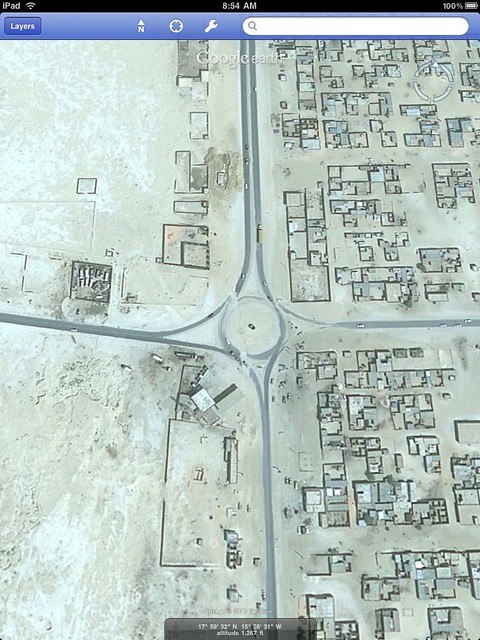
Mauritania roundabout