Wednesday, September 15, 2010

16 Marathons in Africa to Get Your Heart Pumping

Destination marathons are a great way to travel. Instead of simply counting down the days until your vacation, run and cross-train the time away. You'll end up in great shape just in time to enjoy some amazing places. With its deserts, jungles, mountains and beaches, Africa is a great place to consider for your own destination marathon.

To help you decide where to go I've assembled a list, map, and information on 16 marathons in Africa. If one of them catches your interest or you'd like more information click on the appropriate link below the map.

If you know of other marathons in Africa, leave a comment. If you've completed a destination marathon, or are planning one, let me know your story. Leave a comment here or better yet, write a post on your own blog. I'd love to hear about it!

Happy running!
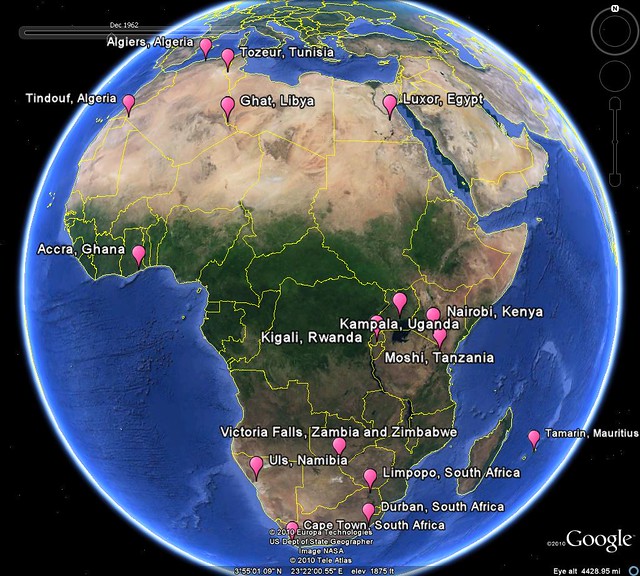
africa marathon

Accra, Ghana
Luxor, Egypt
Tozeur, Tunisia
Tindouf, Algeria
Kigali, Rwanda
Moshi, Tanzania
Limpopo Province, South Africa
Durban, South Africa
Algiers, Algeria
Cape Town, South Africa
Tamarin, Mauritius
Namibia
Nairobi, Kenya
Zambia and Zimbabwe
Kampala, Uganda
Ghat, Libya


The lead up to my marathon:

In 2009 I decided to start training for a marathon. I had tossed around the idea of a destination marathon for some time and realized the time to act was now. A few years earlier I had come across the Christmas Island marathon, and this was where I started my internet searches. I was immediately intrigued at the thought of running around a small island in the Indian Ocean and the prospect of flying through Sydney or perhaps Kuala Lumpur.

Unfortunately, I couldn't find any information on a 2010 Christmas Island marathon. A few more searches revealed the Namibia marathon through Across the Divide. I've already written a post about my experience in Namibia.

Two things have happened since I returned from Namibia:

1. The marathon bug bit me again
2. My last treatment failed to remove the Africa bug

Time for more research!

Monday, September 13, 2010

Socotra and Thoughts of Island Paradises

"Island paradise" evokes different images for different people. For me, it's the intriguing, intertwined landscapes of the islands of Seychelles. For others it's the cascading mountains and lush greens of Hawaii. There is something romantic about the thought of being stranded on a desert island, focusing on oneself and ones survival instead of the every day hustle and bustle of modern life. Robinson Crusoe, who had well documented issues on his own island paradise said "...I looked back upon my desolate, solitary island as the most pleasant place in the world and all the happiness my heart could wish for was to be but there again." Remarkably, our wonderful world is dotted with a plethora of these "pleasant places".

Socotra is a lesser-known island paradise. Near the intersection of the Gulf of Aden, the Arabian Sea and the Indian Ocean, the archipelago offers a host of endemic species. Socotra offers an ecosystem arguably more unique than the Galapagos due to it's multi-million year move away from its Gondwanaland roots.

The beautiful Yemeni archipelago has a young and budding tourism industry. Much of the areas allure is because it remains relatively untouched and unique, not an overbuilt tourist trap. However, to emerge as a legitimate and significant industry, certain amenities and investment need to occur. The government of Yemen faces the challenge of finding the delicate balance between development and preservation. Before a clear path is taken, Socotra struggles with a bit of an identity crisis. Although, with as varied a cultural history as it has, perhaps its ability to evolve while maintaining its natural wonder is the true identity of the archipelago.

Not surprisingly a debate continues as to how Yemen should administer the area. Should it remain largely a preserve or should the government promote tourism on its tropical gem? I found an editorial which argues Socotra is more beautiful than Hawaii and should be developed. I'm not so sure. I'm in the camp that believes the real draw is the relatively pristine and unique ecosystem. At the very least it's an interesting take.

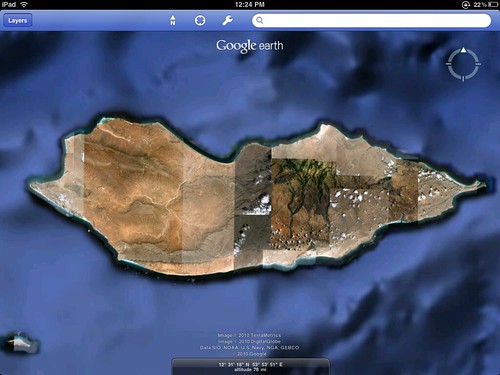
And here is your image of the week, the main island of Socotra. What do you think? Should it be developed, preserved, or a little of both.

socotra

With the recent addition of daily air service from the Yemeni mainland, Socotra has what it takes to be a real player in the eco-tourism market. It's far away, beautiful, safe, accessibly and exotic.

So where is YOUR island paradise?

The basement geographer beat me to the punch on this post. He includes a lot more information on his post on Socotra and some of its native species. Be sure to check him out.

Friday, September 10, 2010

Australia and the 24th Parallel

Being the WORLD Geo Blog, I reckon it's high time we have a post involving Australia, mate. Growing up, my thoughts of Australia most often involved kangaroos, Paul Hogan and the Coriolis effect, although not all at once. The latter was mostly because I realized how very far from down under I existed. Beginning with the miracle of the World Book Encyclopedia and culminating with panoramio photos in Google Earth, my views of Australia have expanded and matured, like a Laphroaig 30. ;)

While this doesn't qualify as a full blown nerd project like my last post on Twitter, inspired by Catholicgauze, it's still a fun way to visualize data!

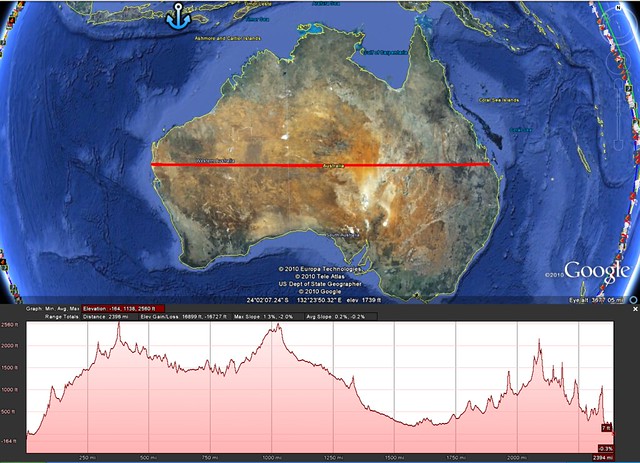
My experience to this point with the Google Earth terrain profile was limited to testing running paths, cities or perhaps small mountains or lakes. Always looking for extremes, I went ahead and drew a much longer path today, 2,400 miles, in across Australia. I chose the 24th parallel because, well, that's where my mouse pointer first clicked. My thought was to find something significant about the parallel. Unfortunately, the southern 24th parallel is the Cooper Manning of parallels- never gaining the notoriety of its bigger brothers, the Tropics of Cancer and Capricorn and dabbling on the edge of forgotten-paralleldom.

Below is a screen shot which shows the 24th parallel drawn across the Australian continent as well as its terrain. Never reaching more than 2600 ft with an average slope of about .2% Australia is the flattest continent. A fascinating continent, though, and one which will be the subject of posts to come on World Geo Blog.

Australia 24th parallel
For more detail, click on the image above.

In case you were wondering, yes, that is Membata marked by the blue anchor. :)

16 Marathons in Africa to Get Your Heart Pumping

Destination marathons are a great way to travel. Instead of simply counting down the days, run and cross-train the time away. You'll end up in great shape just in time to enjoy some amazing places on your trip. With its deserts, jungles, mountains and beaches, Africa is a great place to consider for your own destination marathon.

To help you decide where to go for your destination marathon I've assembled a list, map, and information on 16 marathons in Africa. If one of them catches your interest or you'd like more information click on the appropriate link below the map.

If you know of other marathons in Africa, leave a comment. And if you've completed a destination marathon, or are planning one, let me know your story, either with a comment or a post on your own blog. I'd love to hear about it!

Enjoy!

africa marathon

Accra, Ghana
Luxor, Egypt
Tozeur, Tunisia
Tindouf, Algeria
Kigali, Rwanda
Moshi, Tanzania
Limpopo Province, South Africa
Durban, South Africa
Algiers, Algeria
Cape Town, South Africa
Tamarin, Mauritius
Namibia
Nairobi, Kenya
Zambia and Zimbabwe
Kampala, Uganda
Ghat, Libya


The lead up to my marathon:

In 2009 I decided to start training for a marathon. I had tossed around the idea of a destination marathon for some time and realized the time to act was now. A few years earlier I had come across the Christmas Island marathon, and this was where I started my internet searches. I was immediately intrigued at the thought of running around a small island in the Indian Ocean and the prospect of flying through Sydney or perhaps Kuala Lumpur.

Unfortunately, I couldn't find any information on a 2010 Christmas Island marathon. A few more searches revealed the Namibia marathon through Across the Divide. I've already written a post about my experience in Namibia.

Two things have happened since I returned from Namibia:

1. The marathon bug bit me again
2. My last treatment failed to remove the Africa bug

Time for more research!

Wednesday, September 8, 2010

Twitter Followers of World Leaders Mapped

A few days ago, Geographic Travels made a post about world leaders on twitter. I have a real love-hate relationship with twitter. Twitter offers a world of possibilities but those are only realized by a small few, myself excluded. I end up bouncing between a world of spam and one of inactivity.

So while the post on world leaders using twitter is great by itself, my geo-eye saw data - raw data that craved to be mapped! I searched how many followers each account had to see if the data held anything of particular interest. I've tried before to measure twitter popularity in an interesting yet 100% non-scientific way in a previous nerd project!

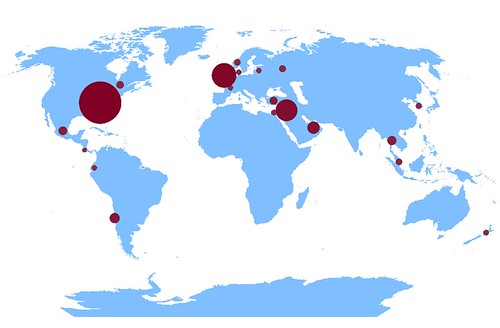
For the map below, I created a new point GIS layer and added info about how many followers each account listed. Now, don't take the scaled symbols too literally. I had to do some scaling when you have Obama at more than 5 million followers and others with barely 1,000. We can't learn much from this map- but it's still cool! I've included the data at the bottom of this post.

The unexpected outlier in this data set is Jordan and Queen Rania Al Abdullah. Although, it doesn't take much to figure out why ;) To find out for yourself, simply do a google search and follower her on twitter @QueenRania.

Twitter Followers
I mention Geographic Travels in part because they are one of the best geography blogs out there. Good blogs are hard to find and finding a good GEOGRAPHY blog is an even greater challenge.

Along with Geographic Travels, I was fortunate to be listed on the recently named 50 Best Geography Blogs for Geography Geeks. The fact that Samantha Rhodes was able to assemble this list of blogs is an accomplishment by itself. What impresses me most is that the listing actually provides a reasonable description of each blog. When I found out I was on the list I was sure that the description of my blog would be straight from my meta tags. It certainly wasn't.

Samantha provided this snippet to describe World Geo Blog "Read World Geography Blog for global news and views about the immensely intimate relationship between people and places." Its a better description than I could ever come up with and I'm thankful for the recommendation.

Go check out the 50 Best Geography Blogs and let me know what else you find!

Also check out another great geography blog I found - The Basement Geographer.

As promised...The Data!

Canada - 64,600
Chile - 195,000
Costa Rica - 1,100
Denmark - 6,100
Ecuador - 5,700
France - 5,200
Israel - 8,500
Jordan - 1,350,000
Latvia - 3,900
Malaysia - 32,500
Mexico - 110,200
New Zealand - 12,600
Norway - 33,200
Russia - 42,900
South Korea - 23,900
Thailand - 126,000
Turkey - 86,800
UAE - 349,000
UK - 1,750,000
USA - 5,300,000

Monday, September 6, 2010

Controversy Over the New Malawian Flag

A flag says a lot about a country. I challenge you to find a color, shape or image placed haphazardly on one. Flags tell a story, and ofter a glimpse of a country's history. But while flags are a source of pride to many, they can symbolize hatred for others.

This was the case in the state of South Carolina, the scene of a row (this is an attempt to use a British idiom - how'd I do?) in 2000 between supporters of the Confederate flag, who saw it as a symbol of state pride and those who opposed it, citing it as an embodiment of racism at the highest level of state government. More recently the old Gadsden flag (shown below) has been take up by the tea party in its infancy as a symbol of conservative ideologies. Whatever your political views, what a flag represents evokes strong feelings for those who fly it.

GadsdenFlag

While in the scheme of history, flags change frequently. The flags of the world carry a certain sense of permanence with them. For this reason it's important we, as geographers and students of the world, take notice when a flag, and therefore a country, undergoes a major change.

Malawian President Bingu wa Mutharika "successfully" implemented a new national flag at the end of July. Mutharika claims that the fully exposed sun "reflect(s) the modern Malawi" and adds that Malawians should be happy about the changes implemented because "Malawi is developed and it is still developing compared to the colonial era". The new flag is shown on the left below, the old flag on the right.


While this seems noble and positive on the surface, its implementation has been extremely controversial. Comments written in English on the Nyasa Times articles about the new flag show a strong stance against the new flag.

Despite Mutharika's claims, Malawi still has a long way to go to attain true economic competitiveness. Malawi ranks 28th on Foreign Policy's failed States index, two higher than Eritrea. The costs of replacing flags is high and it is even illegal to display the country's old flag. The government should be focusing resources towards economic growth and the well-being of it's citizens. Instead, they are wasting money to make unsubstantiated claims about development that cannot be backed up. They are in fact spending money to cover up where their policies have failed.